Welding technology
Precise, reliable welding technology for demanding industrial applications.
Communication methods
Digital communication
Supports digital communication protocols such as CANopen, EtherCAT, and Modbus TCP, and can connect to welding machines with various industrial Ethernet and field bus interfaces.
Analog communication
Features analog communication with analog I/O and digitall I/O communication capabilities, enabling one-click configuration between the welding machine and the robot.
Welding functions
FAIRINO's independently developed welding process package supports various welding techniques, including arcwelding, corner welding, flatwelding, segment welding, and dual-process welding.
1. Weaving welding
FAIRINO's robot weaving function supports various weaving patterns, including triangular wave, vertical L-shape, triangle, circular, inclined sawtooth, and sine wave weaving.

2. Arctracking
Arc trackingis akey technology in welding automation, when welding right-angle, U-shaped, V-shaped and other grooves, the position relationship between the welding gun and the groove center is calculated according to the welding current and voltage information after arcing, andthe weld deviation is compensated in realtime to ensure that the weld position is accurate and thewelding qualityis stable.

3. Seamtracking
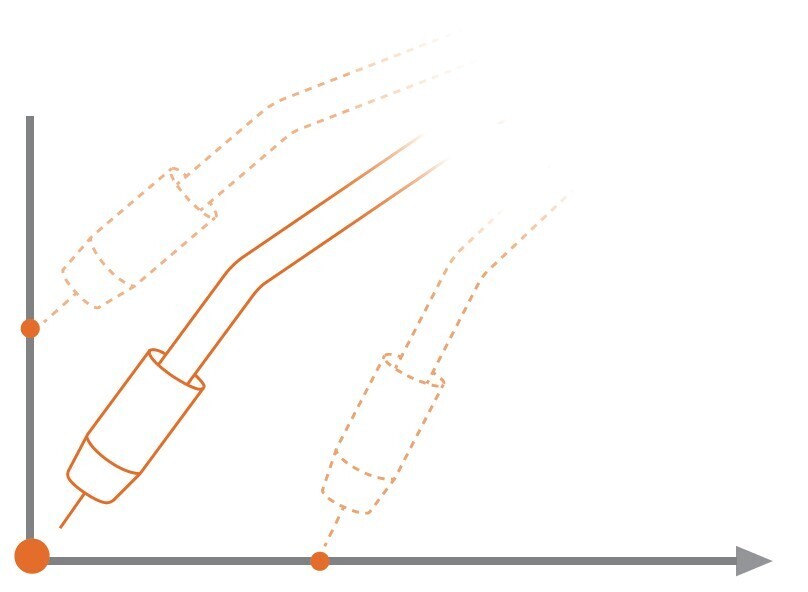
Seam tracking refers to detecting changes in the welding wire's electrical signal upon contact with the work piece surface to determine the work piece's actual position within the robot's coordinate system. After teaching theposition-sensing way points, therobot automatically searches for the work piece surface boundary. When the welding wire touches the work piece surface, a voltage signal change occurs, which the welding machine communicates back to the robot. Upon receiving the signal, the robot records the work piece surface boundary position.
4. Welding interruption recovery
The welding interruption recovery function is used when the welding is interrupted due to the operator's active interruption of welding during thewelding process, or encounters unexpected circumstances such as collisionand arcbreakage, the robot can start the arc again from the original welding interruption position and continueto complete the subsequent welding tasks. when the arc is restarted, therobot will automatically retreat a specified distance along the welding direction to create a lap with the weld before the arc stops to ensure the welding quality.

AIRlab embodied intelligence platform
The FAIRINO AIR Lab laboratory uses advanced visual and motion algorithms to enable collaborative robots to have stronger autonomous learning and decision-making capabilities, enhancing the human-machine experience.
Open platform
The FAIRINO AIR Lab supports a variety of programming languages, including C, C#, Python, Ros, Tcp/IP, providing a rich selection for developers different technical backgrounds. Users can develop secondary applications to expand the robot's application functions based on their needs.
Advantage
Equipped with powerful automatic seam recognition capabilities, using point cloud algorithms to achieve automatic seam recognition with or without models.
No teaching or programming required, capable of predicting welding challenges in advance, eliminating the need for manual modeling, and improving welding preparation efficiency.
Scope of application
Suitable for production scenarios with multiple varieties and small batches, meeting diverse production needs.
Get in touch with us and we’ll be happy to discuss your requirements.
Contact Us